
In Thailand, a foreigner can buy a building but not the land on which it stands. This fundamental legal constraint redefines what it means to “buy a house for 7,000 euros”: at this budget, the transaction concerns a built structure, not a complete land ownership right. Understanding this distinction helps avoid confusing a traditional real estate purchase with a partial property access arrangement.
Foreign quota in condominiums: the lock that price alone cannot unlock
The reflex when working with a limited budget is to look for a small condominium. Foreigners can indeed own a freehold condominium, which is not the case for a house with land.
The limit lies elsewhere. Each condominium building has a quota: the share held by non-Thais cannot exceed 49% of the total area of the building. In popular tourist areas, this quota is often saturated. A budget buyer may therefore find themselves blocked not by the price of the unit, but by the legal unavailability of the desired unit.
This mechanism effectively directs smaller budgets towards less sought-after buildings located on the outskirts of cities like Chiang Mai or in lesser-known provinces. The geographical choice thus becomes a legal variable as much as an economic one. To delve deeper into strategies for reducing the overall cost, a detailed file discusses purchasing a house in Thailand for 7,000 euros with Octroi Immobilier and the concrete levers to activate.
Buying a house in Thailand for 7,000 euros: what this budget really covers
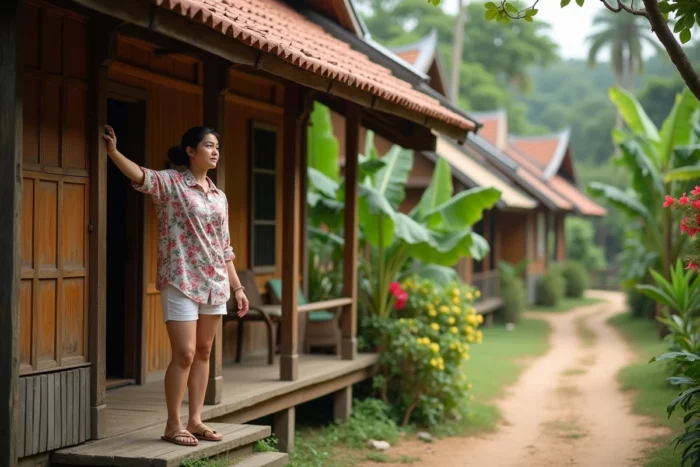
Talking about a house for 7,000 euros implies distinguishing between what pertains to the building and what pertains to the land. Thai law allows a foreigner to own the structure, not the land. At this price point, the most common operation involves acquiring a small built structure (often in rural areas) and leasing the land through a long-term lease, typically set at 30 years renewable.
This lease, called leasehold, is registered at the Land Office. It offers a right to use the land, not a right of ownership. The difference has concrete consequences upon resale: the property loses attractiveness as the lease approaches its end, and renewal is never legally guaranteed.
What 7,000 euros do not cover
- Transfer fees at the Land Office, associated taxes, and fees for a Thai lawyer, which represent a percentage of the sale price to be budgeted additionally
- Verification of the land title (essential to ensure that the seller indeed holds a Chanote, the most reliable land title)
- Any necessary compliance work, common on small rural constructions sold at low prices
A budget of 7,000 euros thus allows access to a habitable structure in certain provinces, but the total cost of the operation almost always exceeds this amount once legal and administrative fees are included.
Land circumvention schemes: risks that are hardening
Some foreign buyers attempt to circumvent the prohibition on owning land by creating a Thai company in which they hold a minority of shares, with the land registered in the company’s name. This arrangement, long tolerated, is now subject to increased scrutiny by Thai authorities.
Convictions have been handed down against foreigners who used Thai nominees as fictitious majority shareholders. The risk is not theoretical: it can lead to the cancellation of the transaction and the loss of the property.
For a budget of 7,000 euros, this type of arrangement is all the more disproportionate as the costs of creating and maintaining a company (annual accounting, general meetings, tax declarations) would consume a significant portion of the available budget.

Liquidity upon resale outside premium areas: a frequently overlooked angle
Buying at a low price in rural or suburban areas raises a question rarely addressed at the time of purchase: the ability to resell. Outside established tourist areas, the liquidity of the Thai real estate market remains low.
A condo bought in Pattaya or Phuket finds a buyer more easily than a small house in Isan, even at an equivalent price. The pool of potential buyers (foreigners subject to the quota, local Thais with limited purchasing power) shrinks considerably as one moves away from attractive hubs.
Before buying, assessing rental demand and the dynamics of the local market provides a more reliable indication than the displayed price alone. A property at 7,000 euros that cannot be resold or rented represents immobilized capital without return.
Fund transfer and banking constraints for a purchase in Thailand
Purchasing a freehold condominium requires that the funds come from abroad and be transferred in foreign currency to a Thai bank account. The receiving bank then issues a document (the Foreign Exchange Transaction Form) without which the registration of the property in the name of a foreigner is refused.
Transfer constraints have tightened in recent years, with increased checks on the source of funds. For an amount of 7,000 euros, exchange and international transfer fees should be compared among several providers, as they can represent a significant portion of the total budget.
Buying a house in Thailand for 7,000 euros is more akin to a partial property access arrangement than a complete land acquisition. The budget allows for the purchase of a modest built structure, not the land. Additional fees, quota constraints in condominiums, and low liquidity outside tourist areas transform what seems like a good deal into a project that requires rigorous legal preparation, preferably with a local lawyer.