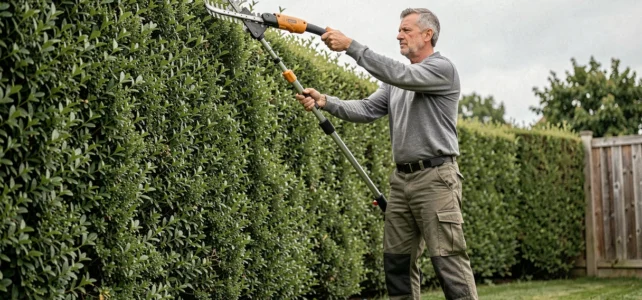
A telescopic hedge trimmer should not be chosen solely based on the length of its pole. The actual manageable reach, the weight in use, and the type of motorization create considerable comfort differences from one model to another. Comparing these parameters before purchase prevents ending up with a device that is too heavy or too short for the hedge to be maintained.
Effective reach and actual weight: differences between motorizations
Catalogs display a pole length, but this data does not always correspond to the useful reach. Futura emphasizes the need to measure the height and depth of the hedge rather than relying on the total length of the device. A long pole becomes useless if the articulation of the cutting head does not allow reaching the top at the correct angle.
Weight varies significantly depending on the power source. Corded models are generally the lightest, as they do not carry a tank or battery. Gas models are the heaviest. Battery models fall in between, but their weight directly depends on the battery pack chosen.
| Criterion | Corded (electric) | Battery | Gas |
|---|---|---|---|
| Relative weight | Lightest | Intermediate | Heaviest |
| Range | Limited by the cord | Free, depending on autonomy | Free, full tank |
| Noise level | Moderate | Low to moderate | High |
| Engine maintenance | Minimal | Minimal | Regular (filter, spark plug) |
| Suitable for tall, distant hedges | No (cord constraint) | Yes | Yes |
For gardens where the hedges exceed the reach of a standard extension cord, battery models offer the best compromise between mobility and muscle fatigue. Detailed product sheets on taille-haie-telescopique.com allow for comparison of these parameters model by model.
Blade and cutting capacity: adapting the tool to branch diameter
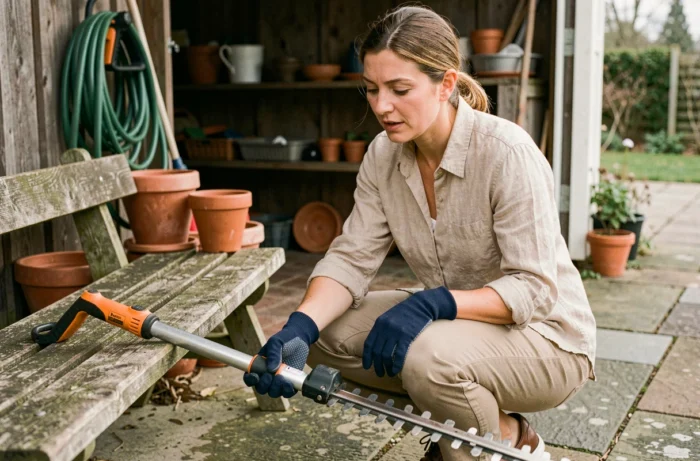
The spacing between the teeth of the blade determines the maximum diameter of branches that the device can cleanly cut. Too narrow spacing against thick twigs causes jams and damages the blade. Wide spacing on a fine hedge results in a less clean cut.
- Close-toothed blades are suitable for boxwood, privet, or hornbeam hedges, whose twigs remain thin if trimmed regularly.
- Wide-toothed blades (greater spacing) are suitable for laurel, Leyland cypress, or eleagnus hedges, which produce stiffer branches.
- The double cutting system (two blades moving in reverse) reduces vibrations compared to the single system, which is particularly important on a telescopic hedge trimmer held at arm’s length for long minutes.
A double cutting system significantly reduces fatigue during prolonged sessions. This point weighs more on a pole model than on a traditional hedge trimmer, as the lever arm amplifies each vibration.
Balance and harness: the criterion that technical sheets overlook
The gross weight displayed on the packaging tells only part of the story. Futura recommends evaluating the balance of the device with the battery mounted and the articulation in working position. A well-balanced model around the main handle tires less than a lighter model whose center of gravity is at the end of the pole.
The harness transforms the user experience. Without a harness, the weight rests entirely on the arms and shoulders. With a suitable harness, the load is distributed across the torso and hips. Some manufacturers provide it as standard, while others sell it separately.
Testing the device in a high position before purchase remains the most reliable method to check that the model suits your morphology and the configuration of your hedge. In-store, simulating a few minutes of trimming with arms raised is enough to spot an imbalance.
Trimming periods and local noise regulations
The choice of trimming period does not depend solely on plant growth. The French Office for Biodiversity recommends avoiding interventions during the main breeding season for birds. Autumn represents the best compromise between maintenance needs and minimal impact on wildlife, according to Futura.
Regarding noise, there is no single national schedule for using a hedge trimmer. Time restrictions depend on municipal or prefectural orders. Futura specifies that it is necessary to consult the town hall or prefecture to know the authorized time slots. A battery model, significantly quieter than a gas one, offers more flexibility in this regard.
Blade maintenance after each session
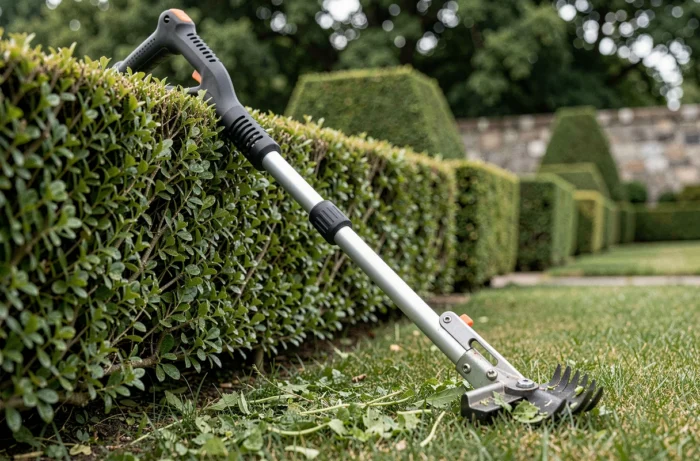
Cleaning the resin and sap accumulated on the teeth after each use preserves the sharpness. A cloth soaked in alcohol or a blade cleaning product is sufficient. Regular sharpening (with a flat file or in a workshop) prolongs the life of the blade and maintains a clean cut that promotes plant healing.
Storing the device with a blade guard prevents accidental shocks and protects the sharp edge between uses. On battery models, removing the battery pack before prolonged storage preserves its cells.
The telescopic hedge trimmer suitable for your garden is one whose actual reach corresponds to the height of your hedge, whose weight remains manageable throughout the session, and whose tooth spacing fits the diameter of the branches to be cut. These three criteria, checked together, matter more than the power displayed on the technical sheet.