
A general practitioner spending their lunch break following up with a lab for test results, a freelance nurse manually re-entering a patient’s vital signs into three different software programs: these situations are not isolated dysfunctions; they are part of the daily routine for many healthcare professionals. The services dedicated to these professionals aim precisely to reduce this type of friction by addressing administrative management, care coordination, and the transmission of medical data.
Administrative burden in practice: what digital tools actually absorb
We first think of consultations, diagnoses, and the relationship with the patient. The reality of a practice also includes billing, electronic submission of care sheets, tracking unpaid bills, and updating patient records. These repetitive and time-consuming tasks eat into time that the practitioner would prefer to dedicate to care.
A well-configured medical software handles the entire chain: from online appointment scheduling to electronic submission to Health Insurance. The digital prescription replaces paper, and the patient record centralizes medical history, prescriptions, and reports. Automated billing reduces coding errors and speeds up reimbursements.
For professionals looking to delegate part of this burden, it is possible to discover the services of Relais Santé that cover several aspects of daily support, from medical secretarial services to logistical management.
The key point to remember: the tool does not replace the professional; it eliminates the steps where their medical expertise is not required. Re-entering a social security number or verifying a CCAM procedure code does not require any clinical expertise but consumes considerable cumulative time over a week of consultations.
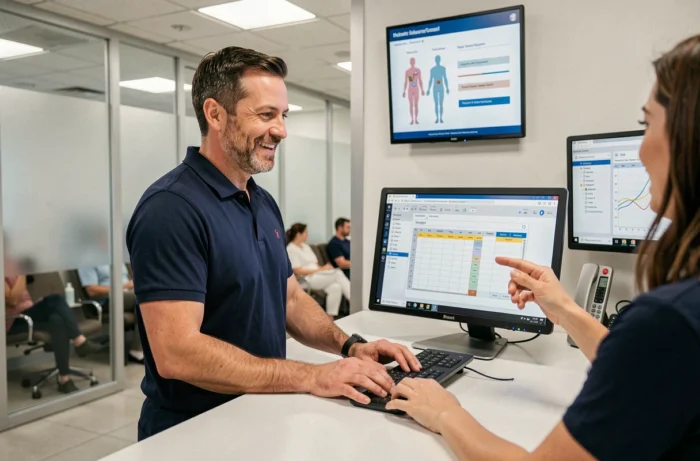
Transmission of health data between professionals: beyond equipment
The Ségur de la santé numérique has accelerated the equipping of practices and establishments. The secure messaging MS Santé, My health space (formerly DMP), Ameli Pro services: the technical building blocks exist. However, the Ministry of Health distinguishes between the deployment of tools and their actual use. Having compatible software does not guarantee that information effectively circulates between the primary care physician, the specialist, and the home nurse.
Interoperability and regulatory framework
Digital health services must comply with a strict framework of interoperability, security, and ethics. The Agency for Digital Health (ANS) offers a “Professional Service Package” that sets connection standards between software. A practice that chooses a non-referenced tool risks becoming isolated, unable to feed into My health space or receive hospital reports.
My health space is also evolving beyond simple document storage. The ministry describes a shift towards prevention and personalization, notably with the possibility for certain referenced applications to transmit specific data (such as glucose data for diabetic patients) directly into the shared record.
What changes concretely for the practitioner
When transmission works, the benefits are immediate:
- The primary care physician receives the hospitalization report without having to follow up with the hospital’s secretariat, directly in their secure messaging
- The freelance nurse accesses updated prescriptions and biological results from the shared patient record, without a phone call
- The pharmacist checks drug interactions based on a complete history, not just an isolated prescription
The gain is not measured in minutes saved but in errors avoided. Missing information about an allergy or ongoing treatment remains one of the leading causes of adverse drug events.
Outsourced services for healthcare professionals: secretarial, on-call, and logistics
Not all services are digital. A significant part of simplifying medical daily life involves outsourcing functions that the practitioner can no longer handle alone, especially in isolated private practice.
Outsourced medical telephone secretarial services handle appointment scheduling, filtering urgent calls, and managing cancellations. For a general practitioner without an on-site secretary, every interrupted call during a consultation represents a loss of quality for the patient in front and a source of stress for the practitioner.
On-call services, managing replacements, supplying consumables, or maintaining medical equipment also fall under dedicated services. These offerings vary according to specialty and mode of practice (individual practice, multi-professional health center, health center), making it difficult to provide a uniform recommendation.

Concrete criteria for evaluating a service for healthcare professionals
In the face of the proliferation of offers, one can structure their choice around a few verifiable points before any commitment:
- Regulatory compliance: certified HDS (Health Data Host) hosting for any service handling patient data, compatibility with the ANS interoperability framework
- The real impact on non-medical time: a good indicator is the reduction in the number of manual tasks per consultation day (re-entries, calls, letters)
- The ability to integrate with existing systems: a service that requires changing the entire software ecosystem of the practice generates more friction than it removes
- The economic model: fixed subscription, commission per act, long-term commitment; these parameters weigh differently depending on the professional’s activity volume
A useful service is one that disappears from the practitioner’s field of awareness because it operates without intervention. If the tool requires as much maintenance as it saves time, the net benefit is zero.
Digital health is progressing rapidly, but actual adoption remains uneven across regions and generations of practitioners. The most reliable criterion for judging a service remains its ability to integrate into existing practices without requiring a complete overhaul of the practice’s organization. It is on this ground, that of operational daily life, that the difference is made.