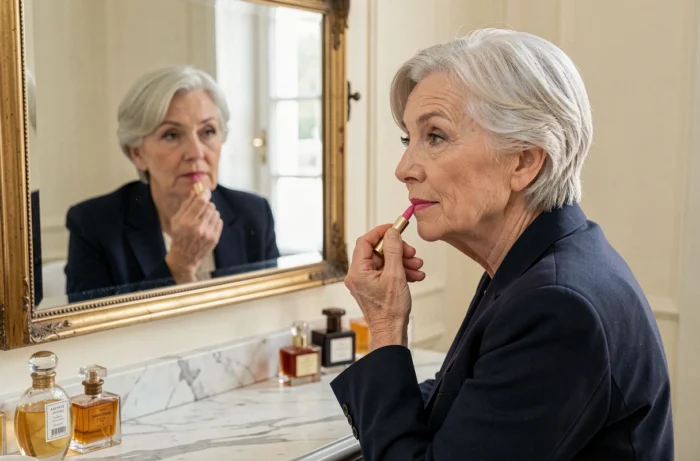
Creamy textures enriched with film-forming agents have replaced classic sticks in the kits of professional makeup artists working on skin over 70 years old. The choice of lipstick at this age is based on three technical parameters that are often poorly prioritized: the viscosity of the formula, the size of the pigments, and compatibility with the actual condition of the lip mucosa.
Formulation and viscosity: what distinguishes a lipstick suitable for mature lips
An overly fluid formula migrates into the perioral fine lines within minutes. Conversely, a stick with a high concentration of hardening waxes pulls on thinned mucosa and accentuates every vertical line. The intermediate viscosity of pigmented balms offers the best compromise: the product stays in place without freezing the mouth.
Next-generation film-forming agents (soft polymers, volatile silicone derivatives) create a veil that holds the pigment without a cardboard effect. This type of formula is recognized by its texture that glides on application and then “sets” slightly after thirty seconds.
The size of the pigment particles also matters. Micronized pigments deposit evenly on an irregular surface, whereas coarse pigments create visible clumps in the folds. Lipsticks sold in pharmacies and parapharmacies sometimes display this mention on the packaging.
We recommend testing the formula on the back of the hand by folding the skin: if the pigment concentrates in the fold, it will do the same on the lips. This simple test avoids many disappointments at the time of purchase. To delve deeper into the subject, knowing which lipstick to choose at 70 according to experts allows for comparison of the latest formulas.
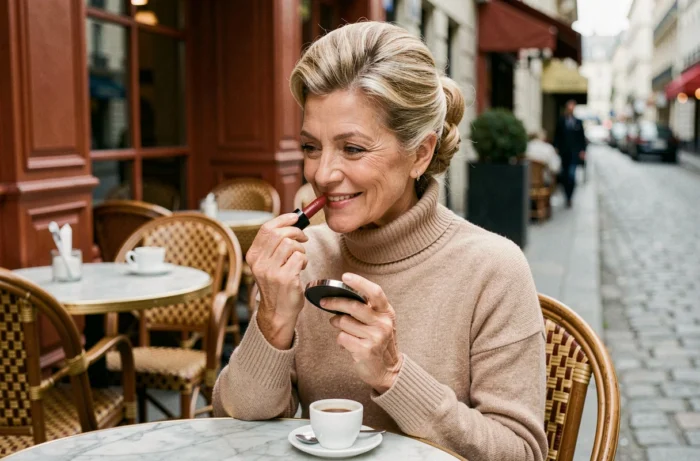
Lipstick colors after 70: undertones and chromatic traps
The most reliable rule remains that of skin undertone, not that of age. A bluish red on a warm undertone complexion yields a dull result, regardless of age. Identifying one’s undertone (warm, cool, or neutral) takes precedence over any generic color recommendation.
The shades that work best on mature lips share a common point: they contain a hint of brown or pink that “anchors” the color in the face instead of laying it on top. Pure reds and highly saturated fuchsias require a sharp outline, which is difficult to achieve when the natural lip shape has blurred.
Colors to test according to undertone
- Warm undertone (greenish veins at the wrist): salmon pink, rosy terracotta, muted orange-red. These shades warm the complexion without creating a harsh contrast.
- Cool undertone (bluish veins): raspberry pink, soft mauve, slightly muted cherry red. They harmonize the face without hardening it.
- Neutral undertone: most medium pinks and “classic” brow-based reds are suitable. This is the most versatile undertone.
Very light shades, like nude beige, can give a “washed-out lips” effect on a mature face. If the goal is discretion, a natural pink with a hint of pigmentation is preferable to a nude that is too pale.
Preparing the lip mucosa: care before color
A lipstick does not correct dehydrated mucosa; it reveals it. Preparing the lips conditions the final result as much as the choice of product itself. On chapped or flaking lips, even the best formula adheres unevenly.
A gentle scrub (once or twice a week, with a fine-grained exfoliating balm or a soft toothbrush) removes dead skin without being aggressive. A repairing balm applied the night before prepares the surface for the next day.
A point often overlooked: chronic lip dryness can stem from external causes unrelated to cosmetics. The MSD Manual cites certain medications, mouth breathing, and food irritants among aggravating factors. If dryness persists despite care, changing texture will not suffice, and medical advice is necessary before seeking the ideal formula.
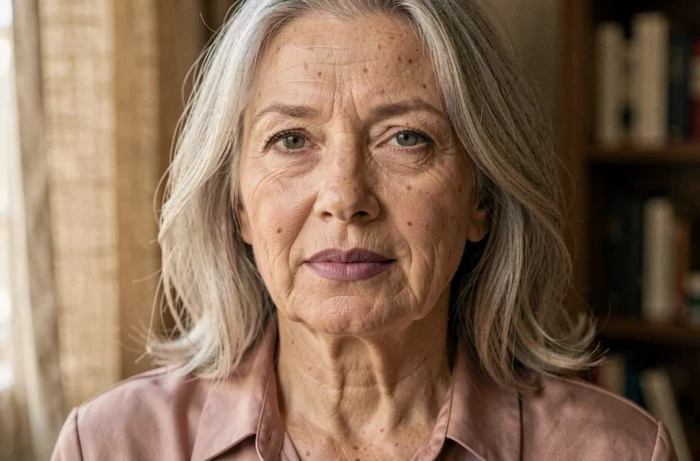
Allergens and ingredient list: a reflex to adopt
The UFC-Que Choisir reminds us that allergens related to fragrances and preservatives can be found in cosmetics, including those labeled as hypoallergenic. On lips sensitized by age or medical treatments, reading the INCI list and discontinuing a product that causes tingling or redness is more useful than any color advice.
Lip pencil and application technique on blended contour
The lip contour loses definition over time. A lip pencil in the same color family as the lipstick (not darker) redraws the boundary without creating a visible artificial frame. The technique involves drawing small short strokes rather than a continuous line, then lightly blending inward with a brush or finger.
Applying lipstick with a brush rather than a stick allows for better control of the amount applied. A thin layer, blotted with a tissue, followed by a second light layer, gives a more durable result than a thick application in one go.
- Outline with small strokes, starting from the Cupid’s bow towards the corners
- Apply lipstick with a fine brush, dabbing rather than stretching
- Blot with a tissue after the first layer to set the pigments
- Add a touch of clear balm to the center of the lower lip for a slight volume effect
Sun protection for the lips also deserves mention: a stick with UVA and UVB filters, reapplied after meals, protects an often-forgotten area. This preventive gesture easily integrates before applying lipstick, without altering the makeup’s longevity.
Lipstick after 70 does not adhere to color prohibitions but to formulation and skin preparation constraints. Choosing an appropriate viscosity and preparing the mucosa changes the result more than hesitating between pink and red.