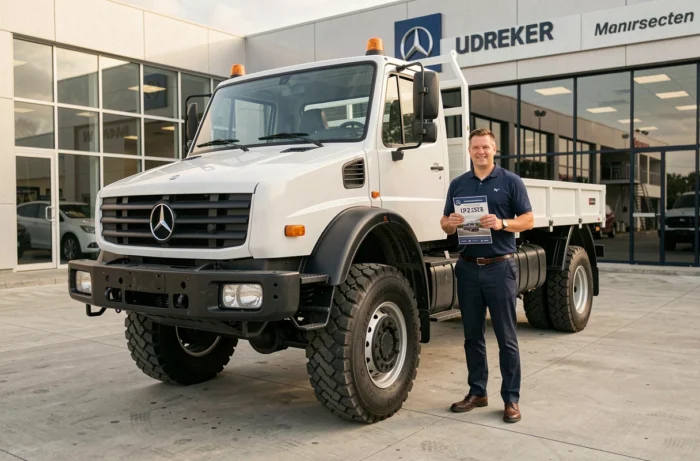
The catalog price of a new Mercedes Unimog almost never corresponds to the final amount paid. Between the bare chassis offered by Mercedes-Benz Special Trucks and the ready-to-work vehicle, the budget gap can double or even triple. Understanding what actually makes up this price helps avoid unpleasant surprises when signing an order form.
Bare chassis, tool carrier, equipped vehicle: three prices for the same name
The most common confusion surrounding the new price of the Unimog stems from a particularity that Mercedes fully embraces: the Unimog is ordered as a base vehicle to be completed. The manufacturer delivers a chassis-cab. Everything else, from the crane arm to the living module, falls under the responsibility of the bodybuilder or equipment supplier.
A bare chassis intended for municipal use has nothing to do, in budget terms, with an Unimog converted into an all-terrain camper. Specialized preparers offer complete vehicles based on the Unimog, with prices that can reach several hundred thousand euros, depending on the engine, equipment, and type of living module.
To reliably compare the new price of the Mercedes Unimog, it is essential to systematically identify at what stage of equipment the displayed price corresponds. A price announced without mentioning the trim level or body type does not allow for any serious comparison.
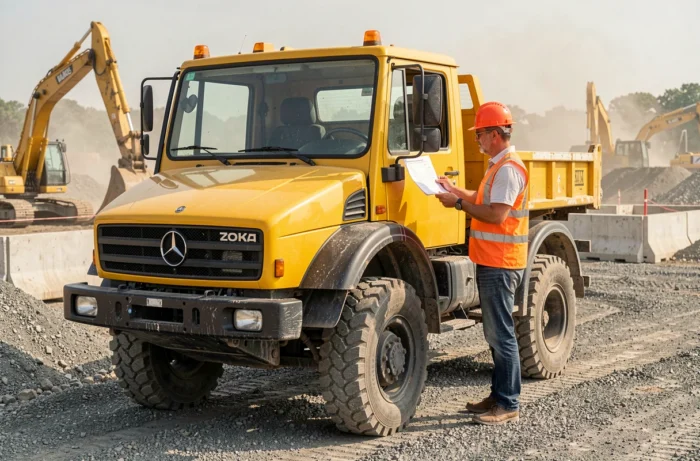
Engine and pollution standard: what affects the Unimog catalog price
The current range offers several diesel engines, from 4 cylinders to 6 cylinders. The choice of engine directly affects the price, as well as the long-term maintenance cost.
The switch to a 6-cylinder engine represents a significant additional cost, justified by the extra power and traction capacity on difficult terrain.
The European emissions regulations add a layer of complexity. Future pollution standards will increase the prices of new heavy vehicles by imposing more sophisticated exhaust treatment systems. For an investor, this means two things:
- An Unimog registered before the implementation of stricter standards could retain a different residual value than a later model, depending on future traffic restrictions.
- Additional pollution control equipment will raise the catalog price, as well as the maintenance bill and repair costs over the vehicle’s entire lifespan.
- The quote must explicitly detail the installed pollution control systems, as their presence is not always included in the base price displayed by the manufacturer.
Driving assistance equipment: check the quote line by line
Recent Unimogs incorporate assistance features that did not exist in previous generations. Attention assist, lane change aid, and sign recognition are part of the systems now offered by Mercedes-Benz Special Trucks.
These devices have a direct impact on the price, but their presence in a quote is not automatic. Some are offered as options, while others are included depending on the market or the version ordered.
The question to ask the dealer is simple: which sensors and assistance features are included in the announced price, and which are charged as extras? A difference of several thousand euros can hinge on these lines. A buyer comparing two quotes without checking this detail risks believing they are getting a better price while actually receiving a less equipped vehicle.

Guide to comparing two new Unimog quotes
The table below summarizes the items to isolate in each commercial proposal. It does not provide prices (which vary according to configuration), but helps structure a coherent comparison.
| Item to check | What to compare |
|---|---|
| Chassis-cab | Exact model (U4023, U5023, U5032), wheelbase, GVW |
| Engine | Number of cylinders, power, applied pollution standard |
| Transmission | Manual or automatic gearbox (EAS), front/rear differential lock |
| Driving assistance | Precise list of sensors and systems included in the price |
| Bodywork / superstructure | Included or not, name of the bodybuilder, associated warranty |
| Cabin comfort options | Air conditioning, pneumatic seats, navigation, rearview camera |
| Manufacturer’s warranty | Duration, mileage, exclusions on the superstructure |
Two quotes are only comparable if each line of this table is filled out. A total price without a breakdown by item prevents any rational analysis.
Total weight and approval: a parameter that modifies the actual budget
The GVW (gross vehicle weight) determines the necessary license, traffic constraints, and insurance costs. Some configurations of the Unimog range fall into the heavy vehicle category, which increases regulatory obligations.
Other lighter configurations remain below thresholds that ease these constraints. Therefore, the choice of GVW significantly influences the total cost of ownership well beyond the purchase price: driver training, heavy vehicle technical inspection, increased tolls, specific insurance.
The new price represents only a fraction of the actual budget for an Unimog. A model that is cheaper to purchase but classified in a higher weight category may cost more over five years than a more expensive model but lighter when empty.
The analysis of an Unimog investment boils down to one discipline: breaking down each quote item by item, checking the applied pollution standard, listing the included assistance features, and projecting the total cost of ownership over the expected operating duration. The price displayed in the showroom is just the starting point for the calculation.