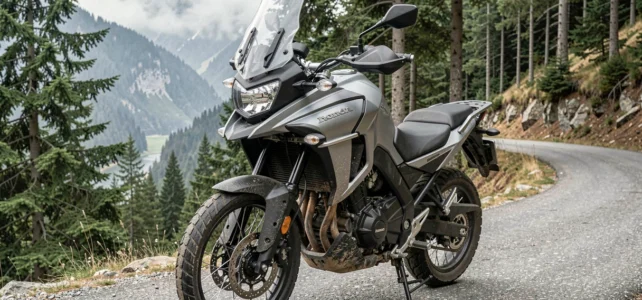
The Honda CB500X is powered by a 471 cm³ parallel twin engine set at 180°, fed by PGM-FI fuel injection. This unit, shared with the CB500F and CBR500R, delivers its power within a deliberately limited RPM range. In a long-term test, it is precisely this economical architecture that defines the character of the motorcycle, far more than the raw power figures.
Performance of the 471 cm³ twin on long road trips
The twin-cylinder engine of the CB500X delivers most of its torque in the mid-range. On national and departmental roads, the motorcycle accelerates without downshifting, with a responsive throttle between 4,000 and 6,500 rpm. This operating range makes for smooth riding through twisty sections and short overtakes.
On the highway, the engine runs at higher RPMs to maintain a steady speed. Vibrations remain subtle in the hands and footpegs, but the handlebars transmit more at speeds above 130 km/h. A long-term test of the Honda CB500X confirms that the engine speed on the highway engages the unit in its upper range without causing early mechanical fatigue.
Fuel consumption regularly drops below 3.5 l/100 km in mixed road and national use. Some long-distance users report even lower averages after several tens of thousands of kilometers, once the engine is fully broken in. With a 17.7-liter tank, the theoretical range easily exceeds 400 km with gentle riding.

Seat comfort and ergonomics on the Honda CB500X after several hundred kilometers
The riding position is high and upright, with a wide handlebar that frees the shoulders. The knees form an open angle, which limits joint compression on long stretches. This ergonomics is particularly suited to average to tall riders.
The seat, firm when new, compresses slightly over time. After two to three hours of continuous riding, discomfort appears at the ischial area. This point is frequently mentioned in long-term feedback.
- The original windshield adequately protects the torso up to moderate speeds but creates turbulence around the helmet at highway speeds. Replacing it with a taller screen significantly improves comfort.
- The original suspension (conventional fork, preload-adjustable monoshock) absorbs road imperfections well. Their limits become apparent on very degraded roads or when carrying a passenger, where the rear travel proves insufficient.
- The bike’s lightweight makes low-speed maneuvers in the city and parking lots easier, a tangible advantage for mixed trips.
Mechanical reliability observed at high mileage
User feedback from those who have exceeded several tens of thousands of kilometers converges on one point: the Honda twin does not exhibit any identified recurring failures. Neither the charging system, nor the clutch, nor the electronics present systematic issues with this unit.
Routine maintenance remains simple and spaced out. Oil change intervals, chain replacement, and brake pad changes follow a predictable schedule. The long-term maintenance cost remains among the lowest in the segment, a factor that short tests cannot evaluate.
The aging of peripherals deserves attention. The electrical wiring, engine mounts, and steering bearings show no premature weakness, but the fork seals require monitoring after significant mileage, especially in mixed use on paved and stabilized paths.
Transition to the NX500: what changes for future buyers
The CB500X has been replaced by the NX500 in European markets. The name change comes with aesthetic and ergonomic adjustments, but the engine block remains fundamentally the same. The gains in reliability and fuel consumption therefore transfer directly to the new model.
For those looking for a used CB500X, this mechanical continuity means that a well-maintained example with high mileage retains real technical relevance. A well-maintained used model offers the same mechanical enjoyment as a recent one.
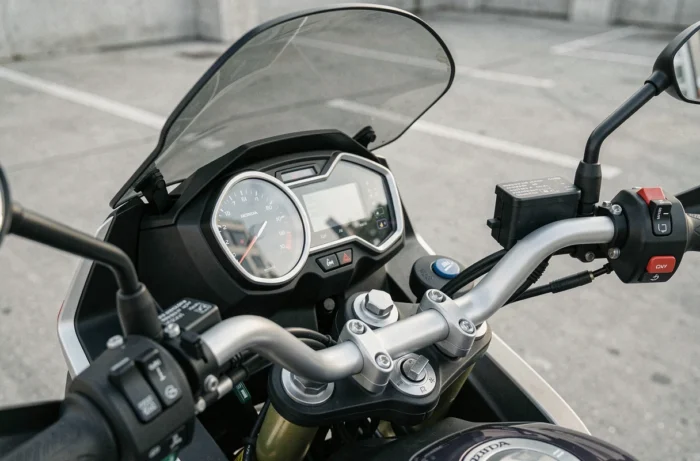
Concrete limits of the CB500X on the road: what the long-term test reveals
The first limitation concerns braking. The ABS system works correctly, but the bite of the front caliper lacks progression during hard braking at high speeds. On a mountainous route with a series of descents, this characteristic fatigues the right wrist.
The second limitation relates to loading capacity. Without a top case or side bags, the motorcycle offers no storage. Adding travel equipment increases the overall weight and alters cornering behavior, particularly the responsiveness at the entry of curves.
The high engine RPM on the highway constitutes the third notable constraint. The CB500X excels on national and departmental roads, but less so on extended highways. Long highway transfers do not match its area of expertise, where it performs best on winding roads at moderate speeds.
The Honda CB500X remains a motorcycle whose coherence reveals itself over time. Its economical engine, documented reliability, and low operating costs make it a daily road tool that ages well. Riders who travel a lot and regularly maintain their machine find a mileage/satisfaction ratio that is hard to match in the segment.