
A telescopic hedge trimmer is not chosen like a classic model. The pole radically changes the distribution of weight, vibrational behavior, and muscle fatigue during prolonged sessions. Here we review the technical criteria that make a difference in the field, beyond the product sheets.
Length of pole and angle adjustment: the underestimated parameters
Most guides focus on power or the type of engine. The parameter that most affects the quality of cutting at height is the fine adjustment of the pole length. A pole that is too long forces you to stretch your arms fully, which overloads the shoulders and lower back. Ergonomic recommendations are clear: the pole should be adjusted so that the elbows remain slightly bent during cutting.
On this point, models with a telescopic pole with notches offer a clear advantage over fixed poles. They allow you to adjust the working distance according to the actual height of the hedge, not the theoretical height stated by the manufacturer.
The angle of the cutting head is as important as the length. A head that can be oriented in several positions (usually between five and seven notches) makes it easier to trim the top of the hedge without straining the wrists. Models with continuous orientation, which are rarer, provide even more precision. Detailed comparisons are available on taille-haie-telescopique.com, allowing you to compare the tilt ranges model by model.
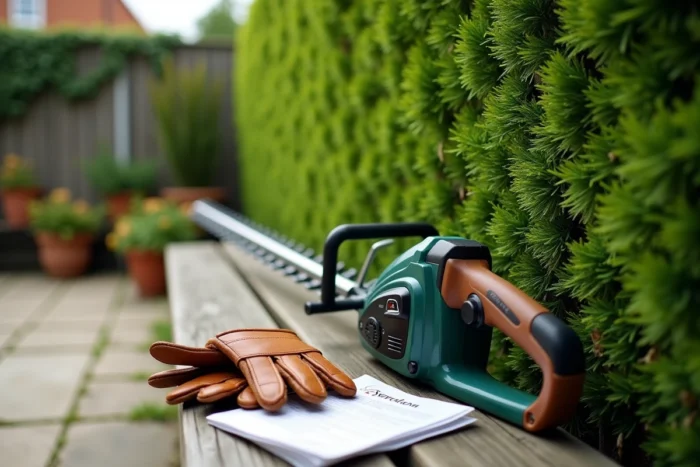
Battery or gas for a telescopic hedge trimmer: decide based on torque, not raw power
The transition to battery is accelerating, even among landscaping professionals. We observe that in recent equipment parks, the proportion of pole tools powered by batteries is rapidly increasing. The reason is not just the sound comfort or the absence of fuel.
The instantaneous torque of a brushless motor often surpasses that of an entry-level gas model on medium-diameter green branches. The electric motor delivers its maximum torque from the start, whereas a small gas engine needs to rev up.
On the other hand, on very dense hedges with semi-woody branches, a higher displacement gas model retains the advantage due to its cutting inertia. The choice therefore depends on the type of vegetation:
- Regularly trimmed thuja, laurel, or privet hedges: a battery model with a wide-toothed blade is sufficient and reduces vibrational fatigue
- Wild or old hedges with woody shoots exceeding one centimeter in diameter: a gas model offers a significant power reserve
- Mixed use (ornamental hedge and fence hedge): prefer a high-end battery platform compatible with other tools from the same manufacturer to amortize the cost of the cells
Weight, vibrations, and musculoskeletal risk: what product sheets don’t tell you
The total weight of a telescopic hedge trimmer is distributed differently depending on the position of the motor. Models with a rear motor or a motor at the lower part of the pole reduce the torque exerted on the arms. A device advertised at the same weight but with the motor block at the top of the pole will be significantly more tiring to handle above shoulder height.
Five-minute breaks every thirty minutes of active cutting are recommended by safety guides on pole pruning tools. This is not a comfort recommendation: it is a preventive measure against musculoskeletal disorders, particularly at the level of the rotator cuff.
The anti-vibration system deserves special attention. Models equipped with silent blocks between the motor and the handle absorb a significant portion of the vibrations transmitted to the hands. During a session of more than an hour, the difference is tangible. We recommend testing the tool in real conditions before purchase, or if not possible, checking for the presence of explicit vibration decoupling in the specifications.

Blade and cutting capacity: tooth spacing and sharpening quality
The blade length on a telescopic model generally ranges from 40 to 60 cm. The longer the blade, the faster the cutting on long stretches, but the more difficult the tool becomes to maneuver at height. A 45 cm blade represents the best compromise between maneuverability and efficiency for residential use.
The spacing of the teeth determines the maximum diameter of branches that the tool can cleanly cut. A wide spacing (around 25-30 mm) is suitable for vigorous hedges. A tight spacing (15-20 mm) provides a neater finish on ornamental hedges with fine foliage.
The quality of the steel and the surface treatment of the blades affect longevity. Blades with a non-stick coating limit sap buildup, which reduces cleaning frequency and preserves cutting sharpness for longer. A factory diamond sharpening, offered by some manufacturers, delays the first resharpening by several seasons.
Cutting periods and regulatory constraints
Since March 2024, the French Office for Biodiversity (OFB) recommends not to trim hedges after March 15 to protect nesting. This recommendation particularly concerns wild hedges and rural areas, but it also influences the maintenance schedule in residential areas.
In practical terms, the cutting window focuses on two time slots: late winter (February to early March) and autumn (September to November). This means that the tool must be operational during short but intensive periods. For a battery model, check that the cells can withstand the low temperatures of late winter, as lithium-ion loses capacity below 5 °C.
The choice of a telescopic hedge trimmer ultimately hinges on three axes: the ergonomic adjustment of the pole, the suitability between the motorization and the type of vegetation, and the quality of the blade. A well-chosen model based on these criteria will last several seasons without causing excessive fatigue or disappointing results.