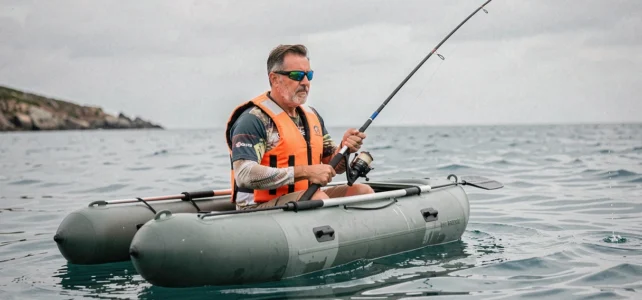
An inflatable kayak designed for sea fishing is not chosen like a model for calm water outings. French regulations draw a clear line between vessels allowed to exceed the coastal band and those confined near the shore, which directly affects the accessible fishing areas. Understanding these technical and regulatory distinctions helps avoid a purchase that would limit your outings even before you’ve cast a line.
Beach craft or sea vessel: the regulatory classification that affects fishing
Most buying guides compare models without addressing the legal constraints that weigh on each outing. An inflatable kayak of less than 3.50 m or one whose manual does not explicitly mention sea navigation is classified as beach craft. This category imposes daytime use within the 300 m band from the shore.
For sea fishing, this limit is a concrete problem. Productive areas (drop-offs, rocky plateaus, offshore wrecks) are often found beyond these 300 m. A high-pressure inflatable of at least 3.50 m, designed for the sea with compliant buoyancy reserves, can legally venture up to 2 nautical miles from shelter, provided it carries the equipment required by Division 240.
Before comparing technical features, you must choose an inflatable canoe for sea fishing by first checking which regulatory category it falls into. An attractive model on paper but classified as beach craft confines you to the immediate coast.
| Criterion | Beach craft | Sea vessel (Division 240) |
|---|---|---|
| Minimum length | Less than 3.50 m | From 3.50 m |
| Allowed distance | 300 m band | Up to 2 nautical miles from shelter |
| Navigation | Daytime only | Daytime (unless additional equipment) |
| Mandatory safety equipment | Minimal | Compliant with Division 240 |
| Access to offshore fishing areas | Very limited | Drop-offs, plateaus, wrecks accessible |
Floor pressure and hull rigidity: the technical specifications to compare
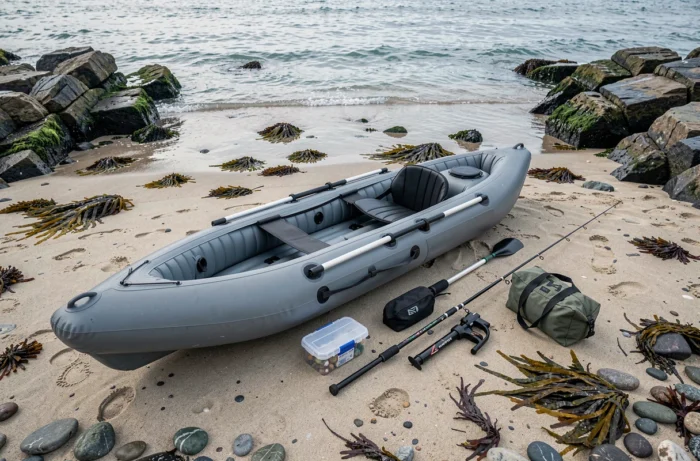
An inflatable kayak designed for the sea is distinguished by the technology of its floor. Models equipped with a high-pressure dropstitch floor offer rigidity comparable to a rigid board. This taut floor prevents the hull from deforming under the effect of waves, maintaining glide and facilitating fishing actions (casting, hooking, handling the fish).
In contrast, a classic low-pressure floor collapses as conditions deteriorate. The kayak becomes soft, the trajectory imprecise, and the stability necessary for fishing disappears. The difference is felt from the first waves.
The material of the hull also plays a direct role in durability. Reinforced multi-layer PVC shells resist better to abrasion against rocks and stray hooks. A fishing kayak endures stresses that touring models do not face: hooks, knives, fish to scale. Reinforced multi-layer PVC protects against accidental punctures.
Stability at sea and fishing layout: what separates a good model from an unsuitable one
The stability of an inflatable kayak at sea relies on two related parameters: the width of the hull and the presence of fins (skegs). A wider model offers better primary stability, which prevents you from tipping over when leaning to catch a fish or handle your gear.
The fins improve course holding against wind and current. Without a fin, the kayak constantly pivots, forcing you to correct the trajectory with the paddle instead of fishing. However, a rigid fin remains fragile near rocks or in shallow water: always check its attachment before each outing.
Specific fishing layout elements
An inflatable kayak designed for fishing is recognizable by details that versatile models do not include:
- Fixed rod holders or anchoring points allowing you to secure rods without holding them, freeing your hands for navigation or unhooking a fish
- Storage spaces accessible from a seated position, sufficient for a cooler, a tackle box, and the mandatory safety equipment
- An elevated seat with a backrest, reducing fatigue during multi-hour outings and improving visibility on the water
- Rails or inserts compatible with third-party accessories (fish finder, GPS mount, floating anchor)
An elevated seat and integrated rod holders turn a few minutes outing into a viable fishing session. Without these features, you will spend more time managing gear than fishing.
Safety equipment and preparation: obligations beyond the kayak itself
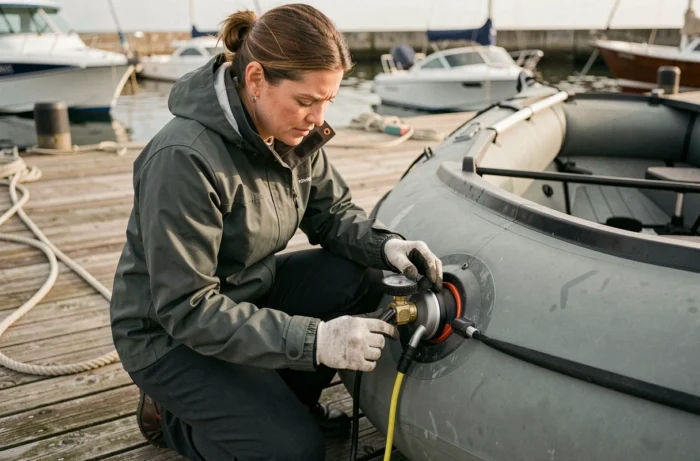
The choice of kayak is just one part of the equation. As soon as you navigate beyond the 300 m band, Division 240 imposes a set of safety devices. A buoyancy vest suitable for sea navigation is mandatory, not just a simple swimming vest.
The list also includes a means of visual signaling, a sound signaling device, and, depending on the distance traveled, additional equipment. A maritime affairs inspection on the water can result in a fine if the equipment is not compliant. These weight and volume constraints must be anticipated when choosing the kayak: a model that is too compact will not be able to carry all the necessary regulatory equipment in addition to fishing gear.
Marine weather deserves special attention. An inflatable kayak, even high-pressure, offers greater wind resistance than a rigid one. Always check the coastal weather bulletin before each outing. A wind of force 3-4 that seems manageable from the beach can make the return very difficult offshore.
The final criterion remains the coherence between the kayak, the targeted fishing area, and the safety equipment on board. A well-chosen model on these three axes opens access to spots that most shore fishermen cannot reach, without compromising on safety or the legality of the outing.