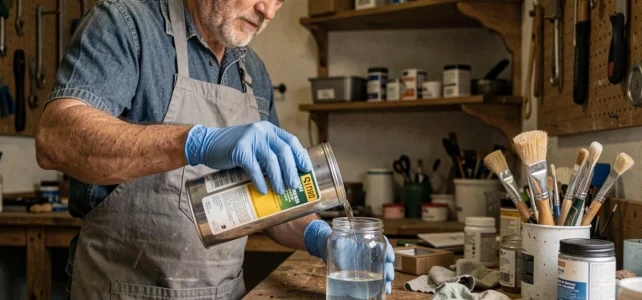
You have a can of dried paint on a brush, a varnish stain on a work surface, or grease on a metal part. You open the cupboard and find two bottles: white spirit and acetone. Which one should you grab?
These two solvents look similar at first glance, but their composition, speed of action, and risks have little in common. Choosing the wrong one can damage a surface, make cleaning ineffective, or expose you to unnecessarily harmful fumes.
Polarity of solvents: the criterion that explains everything else
Before discussing paint or DIY, a simple chemistry point helps to understand why these two products do not do the same job. Acetone is a so-called polar solvent. It mixes with water and dissolves substances that share this polarity: resins, glues, nail polish, certain acrylic paints.
White spirit, on the other hand, is a non-polar solvent. It belongs to the family of mineral spirits derived from petroleum. It dissolves fats, oils, and binders from glycerol or alkyd paints, but does not mix with water.
To understand the difference between white spirit and acetone, just remember this principle: a polar solvent dissolves polar products, a non-polar solvent dissolves non-polar products. This rule avoids most usage errors.
Why does this detail matter so much in practice? Because applying acetone to a glycerol paint stain is like rubbing with a dry cloth: chemistry does not work in your favor. Conversely, cleaning a cyanoacrylate glue mark with white spirit will yield no significant results.
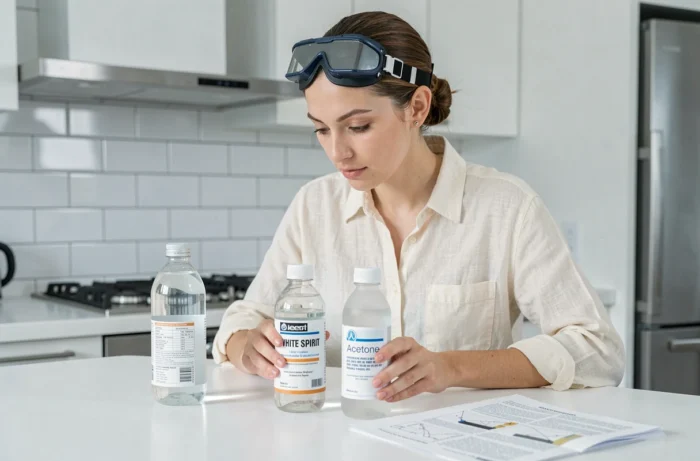
White spirit: a product that varies according to its formulation
White spirit is not a unique product. It is a family of petroleum distillates. In stores, you will find at least two main categories: classic white spirit and the deodorized version.
Classic white spirit and deodorized version
Standard white spirit contains aromatic hydrocarbons. It emits a strong and persistent odor, but its solvent power is slightly higher on stubborn paint residues.
The deodorized version (sometimes labeled “odorless” or “low odor”) has undergone additional treatment to remove these aromatic compounds. The smell is significantly reduced, but the solvent power also decreases. For indoor use, this is often an acceptable compromise.
When white spirit is the right choice
- Cleaning brushes and rollers used with glycerol or alkyd paints: white spirit dissolves the binder of these paints without effort.
- Degreasing metal surfaces before painting, provided you do not need instant drying.
- Diluting certain oil-based paints or stains that mention it on their label.
- Removing tar, wax, or mechanical grease stains from hard surfaces.
White spirit evaporates slowly. This is an advantage when cleaning a tool: you have time to scrub without the solvent disappearing. However, if you are preparing a surface before gluing or painting, this slowness can delay your project.
Acetone: quick drying and sensitive surfaces to watch
Acetone is a very volatile solvent. In a few seconds, it evaporates and leaves the surface dry. This is precisely what makes it useful for degreasing glass or metal before applying paint, gluing, or welding.
You may have noticed that nail polish remover has a strong smell but dries almost instantly? That’s acetone (or a close derivative). This behavior is the same on a glass work surface or a steel part.
Where acetone excels
Quick degreasing on metal and glass: it is the go-to solvent when drying needs to be immediate. It also dissolves residues of glue, uncured epoxy resin, and certain fresh acrylic paints.
Where acetone can cause damage
Acetone attacks many plastics (polystyrene, ABS, polycarbonate). It can also dissolve or dull a varnish, an existing paint film, or a lacquered finish. Always test on a hidden area before applying to a large surface.
DIY feedback regularly reports white marks left by acetone on laminate countertops or painted furniture. White spirit, in these situations, causes less damage because it does not have this chemical aggressiveness towards organic coatings.
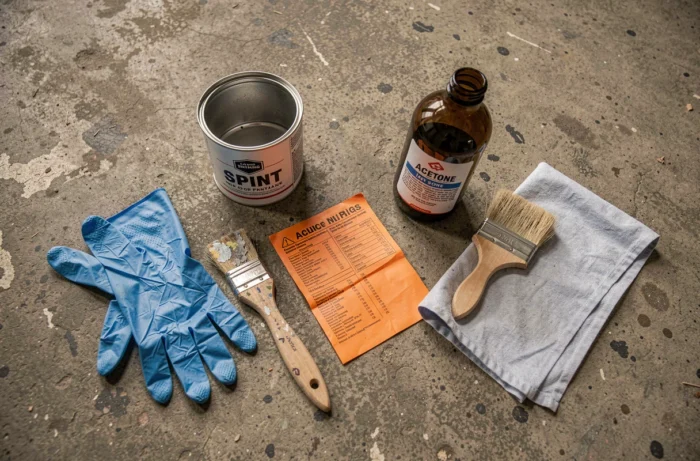
Safety precautions for household solvents
Both products are flammable. Acetone is more so: its vapors can ignite at room temperature. White spirit requires a slightly higher temperature, but the risk remains real near a flame or spark.
Regarding health, acetone is classified as a flammable liquid whose vapors are irritating (hazard mention H226). White spirit can be fatal if ingested and if it enters the respiratory tract (H304), making it a product to be kept strictly out of reach of children.
- Work in a ventilated space, with the window open or mechanical ventilation. The vapors from both solvents accumulate quickly in a closed room.
- Wear solvent-resistant gloves (nitrile, not latex). Acetone passes through latex in a few minutes.
- Keep away from any ignition source: no cigarettes, no space heaters, no electric tools producing sparks nearby.
- Never pour these products down the sink or toilet. Take the leftovers to the recycling center, to the chemical waste collection point.
A common trap: storing both bottles side by side in a non-ventilated garage exposed to sunlight. Heat increases the pressure of vapors in the container and the risk of ignition. A closed, cool cupboard away from direct light remains the best option.
The choice between these two solvents often comes down to the nature of the product to be dissolved and the desired drying speed. White spirit for oil paints and patient degreasing, acetone for quick cleaning on metal or glass. Keeping both in your workshop makes sense, as long as you read the label of the material to be treated before opening the bottle.