
When a neighbor installs a fence that exceeds the authorized height or uses materials prohibited by the local urban planning document (PLU), the situation can quickly become a legal headache. Non-compliance with the local urban planning plan for a fence concerns both the absence of prior declaration and the failure to adhere to height, placement, or appearance requirements. Before considering legal action, several written steps allow you to assert your rights with the neighbor or the town hall.
Check the prior declaration procedure before taking any action
Most municipalities require a prior declaration for the installation of a fence, using the Cerfa form n°13703. This point is often overlooked in contestation letters, even though it constitutes a concrete lever.
For municipalities with more than 3,500 inhabitants, the digital submission of urban planning authorizations is now mandatory. If your neighbor has installed their fence without going through this procedure, the absence of prior declaration is an independent reason for reporting to the town hall’s urban planning department, regardless of the physical compliance of the structure.
In your letter to the town hall, mentioning the absence of prior declaration strengthens the request. You can refer to a template letter for non-compliance with PLU fence to structure this process with the correct regulatory references.
Before writing anything, obtain from your town hall the articles of the PLU applicable to your area. The rules vary from one municipality to another: some limit the height to a specific threshold, while others impose a type of material (fencing, plant hedge, specific color coating). Without these elements in hand, your letter will lack a legal basis.

Friendly letter to the neighbor: what it must contain to be taken seriously
The friendly letter sent directly to the neighbor is the first step. This is not a formal notice, but a written document that sets the framework and establishes a record.
An effective friendly letter precisely identifies the observed violation. Avoid vague phrases like “your fence is not compliant.” Specify the issue: height measured against the PLU threshold, unauthorized material in the area, property line placement not compliant with local regulations.
The elements to include in this letter:
- Your complete contact details and those of the recipient, along with the cadastral references of both parcels
- A factual description of the disputed fence (estimated height, material, location)
- A precise reference to the articles of the PLU or the applicable urban planning document, obtained from the urban planning department
- A reasonable deadline to regularize the situation (generally a few weeks)
- A mention that in the absence of a response, you will contact the town hall or initiate legal action
Send this letter by registered mail with acknowledgment of receipt. This precaution is not trivial: in the event of subsequent legal action, the judge will check that you attempted an amicable resolution.
Reporting to the mayor and requesting an infringement notice
If the neighbor does not respond or refuses to comply, the next step is to contact the mayor. The mayor has police powers in urban planning matters and can recognize an infringement of the PLU rules.
Your letter to the mayor must be distinct from the letter to the neighbor. It is addressed to the competent authority and explicitly requests intervention. Attach a copy of the friendly letter sent to the neighbor, the acknowledgment of receipt, and dated photos of the fence.
The points to clearly formulate:
- The description of the fence and its location (address, cadastral references)
- The articles of the PLU that you believe have been violated, with exact citation
- The request for an infringement notice by a sworn agent
- The request for a formal notice to the offender to regularize or demolish the non-compliant structure
In practice, the mayor is not required to act within a fixed timeframe. Field reports vary on this point: some mayors intervene quickly, while others delay. If the mayor remains inactive after a reasonable period, you can send a follow-up by registered mail, then consider legal action before the administrative tribunal for inaction by the municipal authority.
When the mayor issues a work stoppage order
If the fence is being installed, the mayor can issue a work stoppage order. This measure is distinct from the demolition notice, which occurs once the structure is completed. In your letter, specify whether the work is ongoing or finished, as the administrative response will differ.
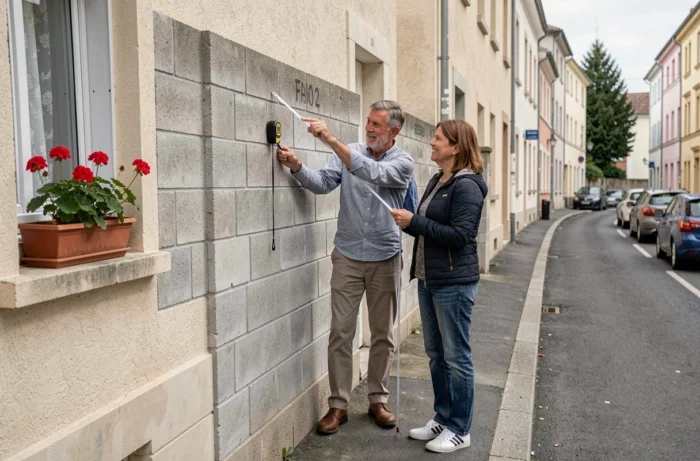
Legal action before the tribunal: last resort after amicable failure
When neither the neighbor nor the town hall responds, legal action before the tribunal remains possible. Two avenues coexist depending on the nature of the dispute.
The judicial tribunal is competent for disputes between individuals related to property rights and neighborhood disturbances. You can request compliance or demolition of the fence, and possibly damages if you demonstrate harm (loss of sunlight, depreciation of the land).
The administrative tribunal, on the other hand, is competent if you contest the mayor’s inaction or if an urban planning authorization has been granted for the fence and you wish to challenge it. The deadline for appealing against an urban planning authorization begins from the posting on the site.
In both cases, keep all exchanged letters: the friendly letter, the report to the mayor, the responses received, and the time-stamped photos. A well-documented file from the first letter greatly simplifies the contentious procedure.
Resorting to the tribunal involves costs and delays. Before reaching that point, some municipalities offer mediation through a justice conciliator, free of charge. This option is worth trying if dialogue with the neighbor is not completely broken.
Each step, from the friendly letter to the report to the town hall, produces a file document. Even if the situation resolves without going to court, these documents protect in case of resale of the property or a new dispute over the same parcel.