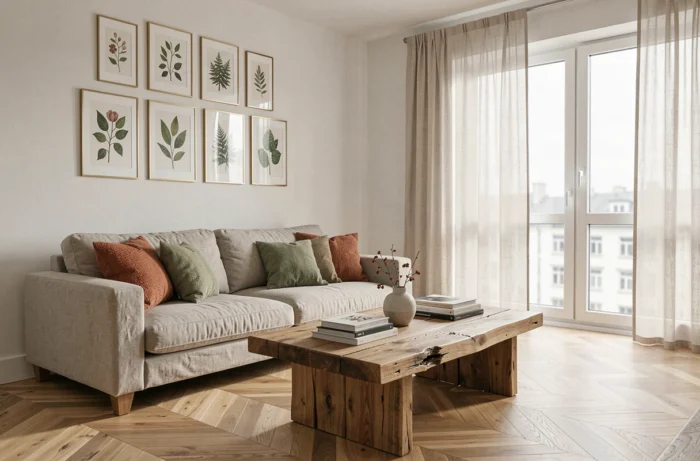
An interior that works relies on technical choices, not on an accumulation of objects. Elevating a home is primarily about mastering the interactions between light, materials, proportions, and the actual use of each room. Here, we discuss concrete levers that transform a space without resorting to the generic recipes found in catalogs.
Decorative textiles and thermal performance: an underutilized lever
Curtains, rugs, and wall weavings are not just ambiance accessories. Their thermal role, long relegated to the background, is now at the forefront of interior design projects. A lined thick linen curtain placed in front of a poorly insulated window significantly reduces heat loss, and a dense rug on a tiled floor corrects a cold sensation that paint or furniture will never resolve.
We recommend thinking in thermal function before decorative function. The choice of a wool wall weaving, for example, impacts both acoustics and the thermal inertia of a lightweight partition. This is a measurable comfort gain in daily life, not just an aesthetic choice.
To deepen your research on this type of project, you can access the Home Dream home section which details several material approaches by room.
Three criteria to check before investing in a structural textile:
- The density of the weave: a sufficiently dense weight insulates better than a thin fabric artificially lined. Favor long fibers (linen, hemp, virgin wool).
- The compatibility with the room’s humidity: thick velvet in a poorly ventilated bathroom generates mold, not comfort.
- The actual maintenance: a hand-knotted Berber rug ages well, while a synthetic long-pile rug flattens in a few months and loses all insulating capacity.
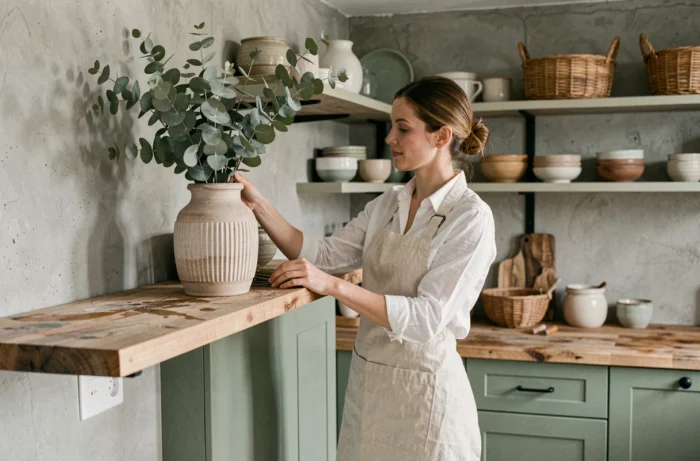
Reuse of furniture and circular economy: going beyond vintage aesthetics
The “second hand” trend has popularized thrifted furniture, but reuse remains very minor in decoration projects. Most interiors labeled “vintage” integrate one or two old pieces drowned in new mass-produced furniture. This is not reuse; it’s styling.
A circular approach requires sourcing furniture based on its structure, repairability, and the origin of its materials. A solid walnut sideboard from the 1960s, even if damaged on the surface, offers a quality of assembly that most entry-level new furniture no longer provides. Sanding it, treating it with hard oil, and replacing its handles costs less than an equivalent particle board piece.
We observe that the most coherent projects mix three or four reused pieces (table, seating, storage) with new elements limited to lighting and textiles. This proportion gives the living room or main room a material density that a 100% new interior struggles to achieve.
Colors and materials: balancing trend and durability of use
A wall painted in terracotta will be dated in three years. A lime-sand render in a similar tone will last a decade without becoming tiresome. The difference lies not in the color itself, but in the type of finish and depth of material.
Standard matte paints hide imperfections but flatten light. A lime wash, applied in two crossed coats, creates micro-variations in hue that react differently depending on the time of day. The material cost is comparable, the installation time is longer, but the result ages instead of degrading.
Combining materials by texture contrast
The classic mistake is to match materials by color. We recommend instead to compose by texture contrast on a limited palette. Raw wood against patinated metal, natural stone against soft textile, polished concrete against tanned leather. This play of surfaces gives each element its own presence without overwhelming the space.
In a living room, three dominant materials are sufficient. Beyond that, the eye no longer prioritizes, and the ambiance becomes confusing. Better to have a solid oak floor, a beige linen sofa, and a brushed steel coffee table than a patchwork of five wood species and four types of fabric.
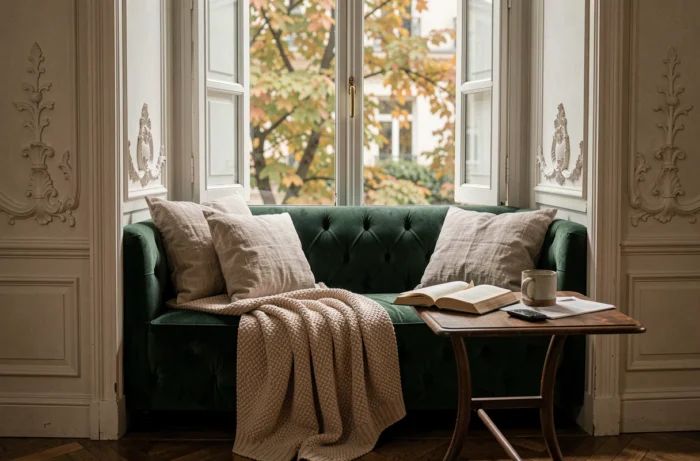
Artisanal traceability: what distinguishes a unique interior from a decorated one
Recent trends in artisanal crafts now combine material origin, manufacturing transparency, and contemporary design. A ceramic light fixture turned by an identifiable workshop, a zellige backsplash installed by a tiler who knows the provenance of each batch: it is this traceability that creates the uniqueness of an interior, not the volume of accumulated objects.
Local craftsmanship is evolving towards documented requirements. A good craftsman provides the material sheet of their product. If your carpenter cannot name the wood species, the sawmill, and the type of finish, the result will be generic, regardless of the price paid.
Prioritize visually impactful pieces
One well-placed artisanal element structures a room more than a dozen decorative accessories. A hammered brass pendant above a dining table, a framed mirror made from reclaimed wood in an entryway: these pieces become focal points around which the rest of the furniture naturally organizes.
The craftsmanship budget therefore focuses on two or three objects per living space. The rest can remain understated, even industrial. It is precisely this controlled contrast between exceptional pieces and a neutral background that gives an interior its signature without an effect of saturation.
The quality of a decoration project is not measured by the number of interventions, but by the relevance of each choice. A textile that insulates, a reused piece of furniture that lasts, a material whose origin is known: these decisions build a space that withstands time, not just trends.