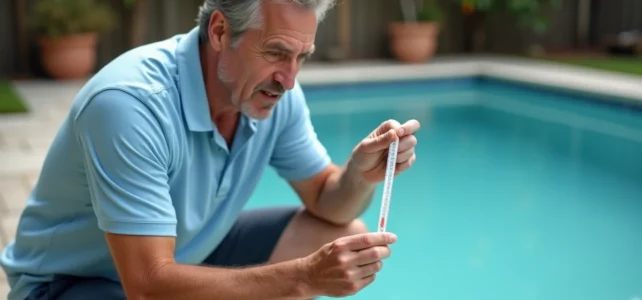
A clarifier poured in too large a quantity into the pool does not dissipate on its own. The product clumps fine particles in suspension to make them filterable, but in excess, it produces the opposite effect: the water becomes laden with polymers that make it milky, foam appears on the surface, and the filter clogs up within a few hours.
The difficulty, since the tightening of regulations on pool water discharge, is that the most direct solution (draining part of the pool) is no longer always feasible.
Filter clogging after overdosage of clarifier: the damage that is underestimated
The first reflex when faced with cloudy water after an excess of clarifier is often to force the filtration. The reasoning seems logical: if the product clumps the particles, the filter should retain them. In practice, it is the filter itself that suffers.
A repeated or massive overdosage can permanently clog certain fine filtering media, particularly cartridges, filter bags, and diatomaceous earth systems. The excess polymer forms a gelatinous layer on the media that does not come off with a simple backwash. Sand filters resist better, but sand clogged with clarifier loses its fine retention capacity.
Before restarting the system, it is essential to assess the state of the filtering media. If you notice that the filter’s pressure gauge rises abnormally quickly after a backwash, the media is likely saturated. In this case, an early replacement of the media (sand, filter glass, cartridge) becomes necessary.
Knowing what to do after a pool clarifier overdosage first requires checking if your filtration is still functional, even before correcting the water chemistry.
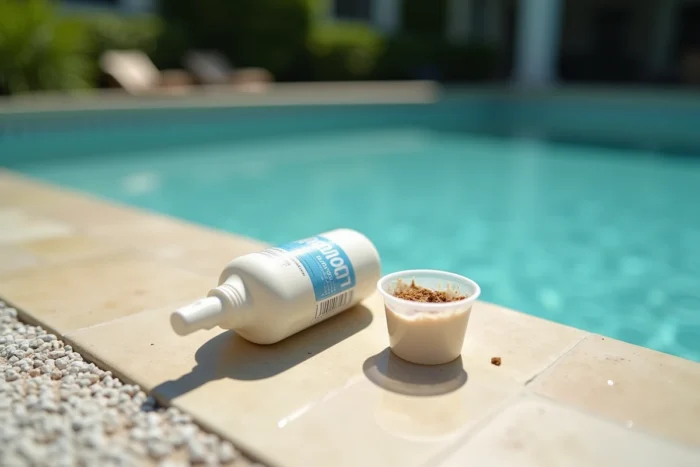
Recovery protocol without draining: filtration and suitable media
Partial draining remains the most effective action to dilute an excess of chemical product in the pool. Recent regulatory constraints change the situation. In sensitive areas, the discharge of water containing treatment auxiliaries into the natural environment is increasingly regulated, or even prohibited. The discharge must then go through the sanitation network, which requires prior authorization and sometimes specific recovery devices.
When draining is limited, one must work with the existing water. Here is a protocol that prioritizes intensive filtration rather than renewal:
- Set the filtration to continuous mode for at least 48 hours. The excess clarifier continues to clump the particles: the filter must run uninterrupted to capture them as they accumulate.
- Perform frequent backwashes (every 6 to 8 hours during the acute phase) to remove the accumulated load in the filtering media. Monitor the pressure gauge between each cycle.
- Consider a more efficient filtering media if the standard sand filter is insufficient. Filter glass offers superior filtration fineness and resists clogging by clarifier polymers better.
- Use a pool-compatible anti-foam product if the surface of the pool shows persistent foam. The product does not address the overdosage itself, but it prevents the foam from disrupting the skimmer and reducing suction.
Intensive filtration is the main lever when draining is not possible. It requires patience: depending on the amount of excess clarifier, returning to clear water can take from two to five days.
The trap of shock chlorine treatment in parallel
Some owners add a shock chlorine treatment simultaneously with intensive filtration, thinking it will speed up clarification. The interaction between excess polymer clarifier and a massive dose of chlorine can produce the opposite of the desired effect: chlorine partially degrades the polymer without eliminating it, creating by-products that maintain the cloudiness.
It is better to wait until the filtration has reduced the clarifier load before considering a shock chlorine treatment. First, check the pH (which should remain within the usual range) and let the filter do its job.
Regulatory constraints on pool water discharge: what is changing
The regulation of pool water discharges is not new, but recent recommendations from ARS and certain local authorities have tightened the conditions. The central point concerns water laden with treatment auxiliaries: clarifiers, flocculants, algicides. In areas with collective sanitation, discharging into the network often requires the manager’s agreement. In individual sanitation areas or direct discharge into a ditch, prohibitions are multiplying.
This evolution has a direct consequence on managing an overdosage. The classic response (draining a third of the pool and topping up with fresh water) becomes administratively complicated, if not impossible in certain municipalities. For large volume pools, the amount of water involved makes the problem even more acute.
This constraint pushes for a preventive approach: measure the clarifier with a precise measurement rather than by visual estimation. Most overdosages come from an approximate gesture, often because the owner poured the product directly from the container without using a graduated measuring device.
Preventing pool clarifier overdosage: common mistakes
The clarifier is not a common treatment product like chlorine. Its use is occasional, meaning that many pool owners do not master its dosage well. Two mistakes are consistently made.
The first is confusing clarifier with flocculant. Both products clump fine particles, but their modes of action differ. The flocculant creates heavy clumps that sink to the bottom of the pool (to be vacuumed later), while the clarifier produces aggregates light enough to be captured by the filter. Using the dosage of a flocculant for a clarifier almost systematically leads to overdosage.
The second mistake is redosing too quickly. A clarifier takes several hours to produce its full effect. Pouring a second dose because the water has not cleared after an hour is the typical scenario of overdosage. The reaction time depends on the water temperature, filtration flow rate, and particle load.
Clarifier overdosage remains a recoverable incident in the vast majority of cases. Continuous filtration, monitoring the pressure gauge, and replacing the filtering media if necessary are sufficient to restore the situation. The regulatory constraint on discharges simply makes the operation longer than a partial drain, which requires a bit of method and especially not stacking chemical treatments out of impatience.