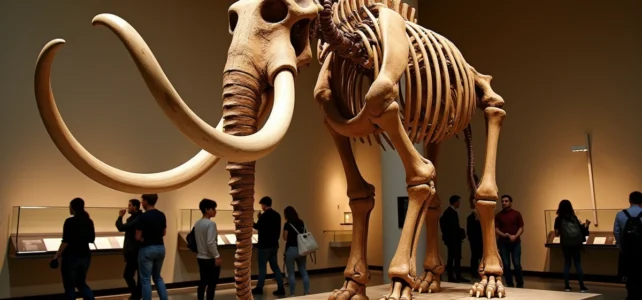
The extinction of mammoths did not occur in a single wave. Recent genetic and paleontological data show regional extinctions staggered over several millennia, with continental populations disappearing long before the last island groups. Understanding this phenomenon requires measuring the gap between these different phases and identifying the factors that influenced each stage.
Comparative Timeline of Regional Mammoth Extinctions
Mammoths did not disappear everywhere at the same time. Populations in Western Europe and North America went extinct at distinct times from those that survived in the Arctic. The last known woolly mammoths lived on Wrangel Island, north of Siberia, where a colony persisted for several millennia after the continental populations had vanished.
| Population | Estimated Extinction Period | Main Context |
|---|---|---|
| Continental populations (Eurasia, North America) | End of the Pleistocene | Climate warming, human expansion |
| Last island population (Wrangel Island) | About 4,000 years ago | Isolation, genetic erosion, likely sudden event |
This gap of several millennia between the disappearance of large continental herds and that of the last island survivors is a central point. It shows that extinction followed different trajectories depending on the regions, based on the local combination of environmental and human pressures.
To better understand why mammoths went extinct, it is necessary to examine these two phases separately: the mass disappearance on the continents, followed by the final collapse of isolated populations.

Climate Warming and Habitat Loss of Continental Mammoths
The end of the last Ice Age brought about a profound transformation of Arctic and subarctic landscapes. The vast cold and dry steppes that nourished the mammoths, rich in grasses, gradually gave way to peatlands, coniferous forests, and wetlands unsuitable for their diet.
This loss of steppe habitat fragmented populations. Once-connected herds became isolated in increasingly restricted pockets of territory, reducing opportunities for seasonal migration and access to sufficient resources.
Human Pressure as an Aggravating Factor
Warming alone does not explain everything. The expansion of human groups into mammoth territories coincided with the terminal phase of the species on the continents. Recent syntheses emphasize the interaction between these two factors: the combination of warming, habitat loss, and hunting was more decisive than a single cause.
Populations already weakened by food stress and fragmentation of their territory became more vulnerable to human predation. Even moderate hunting pressure could be enough to push a declining population past a point of no return.
- Warming reduced the area of mammoth steppe, the species’ main habitat
- Population fragmentation limited genetic exchange and migrations
- Human hunting, even at low intensity, accelerated the decline of already weakened groups
Genetic Erosion on Wrangel Island: The Fragility of the Last Survivors
The case of Wrangel Island serves as a natural laboratory for understanding the end of a species in isolation. This island population survived for millennia after the continental extinction, but under increasingly precarious conditions.
Ancient DNA analyses revealed a gradual erosion of genetic diversity within this colony. Geographical isolation prevented any influx of external genes, which reduced the ability to adapt to diseases, parasites, or environmental changes.
A Likely Sudden Final Collapse
The team of Anders Angerbjorn (Stockholm University) analyzed mitochondrial DNA fragments from Wrangel mammoths to assess whether inbreeding had caused their loss. The results suggest that the final disappearance is likely not related to gradual climate change, but rather to a sudden event.
Several hypotheses have been proposed to explain this final blow:
- A major storm or extreme weather event affecting an already reduced population
- The introduction of a new disease against which the genetically impoverished mammoths had no defense
- An episode of famine related to a local and temporary disturbance of vegetation
Carbon-14 dating indicates that at least a few mammoths were still present on Wrangel around 1,700 BC. This means that this species coexisted with already advanced human civilizations, with the pyramids of Egypt already being built at that time.
Mammoth Extinction and the Disappearance of Megafauna: A Broader Phenomenon
The mammoth is not an isolated case. Its extinction is part of the Holocene megafauna extinction, which affected many species of large mammals across several continents. Woolly rhinoceroses, megaceroses, giant sloths: the same pattern of warming combined with human expansion is found for other species.
This parallel shows that mammoths were not particularly vulnerable compared to their contemporaries. Their imposing size, slow reproductive cycle, and dependence on a specific habitat placed them in the same risk category as other large herbivores of the time.
In contrast, the woolly mammoth remains the best documented due to the exceptional preservation of specimens in Siberian permafrost, allowing for DNA analyses impossible for other extinct species. This wealth of genetic data explains why the scientific debate on mammoth extinction continues to evolve with each new discovery.
The extinction of mammoths results from a chain of factors rather than a single cause. Warming destroyed their habitat, hunting accelerated their continental decline, isolation eroded their genetic heritage, and a local event likely finished off the last survivors of Wrangel. What is striking is the slowness of the process on the continents, followed by the brutality of the end on an island.