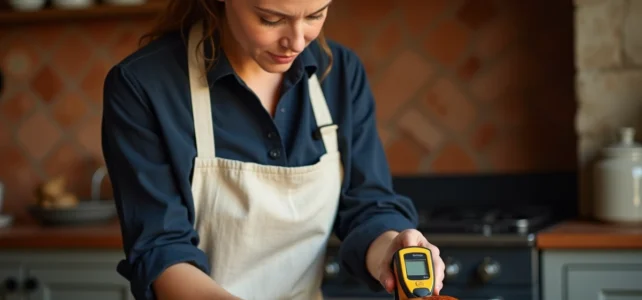
A roast taken out of the oven too soon, vegetables turned to mush, a fish that crumbles under the spatula: cooking time is the parameter that separates a successful dish from a failed one. The problem is that the timings indicated in recipes do not take into account your oven, the actual thickness of your food, or its temperature when you put it in the oven.
Mastering the cooking of your favorite dishes involves a few simple technical reflexes, much more reliable than a stopwatch set blindly.
Internal temperature of foods: the benchmark that the timer cannot replace
Have you ever noticed that a chicken cooked for exactly the same time can be perfect one Sunday and pink near the bone the next? The difference rarely comes from the oven. It comes from the temperature of the meat before cooking.
A chicken taken out of the refrigerator at 4 °C does not react like a chicken left at room temperature for twenty minutes. The center takes longer to heat up, and the outside has time to dry out while the inside catches up.
The cooking thermometer solves this problem. Instead of relying on a theoretical duration, you aim for a target temperature. To explore the benchmarks of cooking times on Double Portion, you will find sheets by type of food that complement this approach.
The thermometer measures reality, the timer measures an estimate. This is why professional cooks insert a probe into each piece of meat, even when they know the recipe by heart.
Adapting cooking according to your type of oven
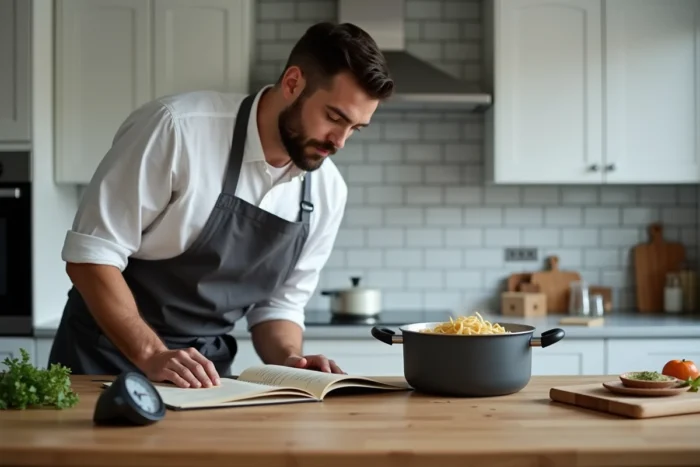
Not all ovens heat the same way, and this is a common source of error when following a recipe to the letter. A static oven concentrates heat at the top and bottom. A convection oven circulates hot air with a fan, which envelops the food more evenly.
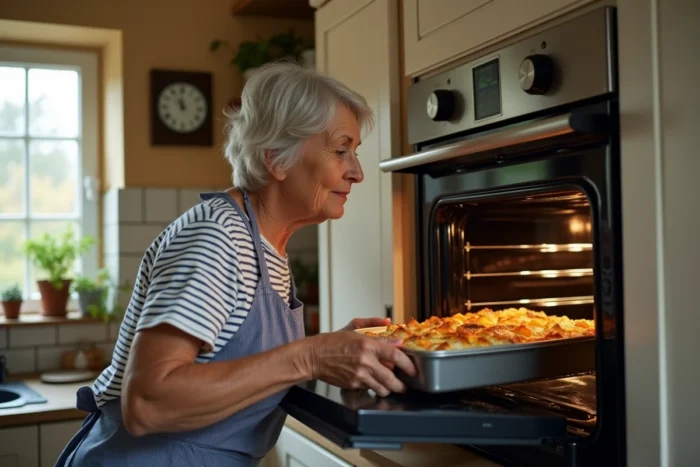
The practical consequence is direct: convection reduces cooking time by about 15 to 20% compared to a static oven. It also requires lowering the temperature by about twenty degrees. A gratin dauphinois whose recipe indicates 200 °C in static mode should be cooked at around 180 °C in convection mode, for a shorter duration.
The case of the air fryer
The air fryer operates on the same convection principle, but in a much smaller space. The air circulates faster, and the temperature rises more quickly. Classic recipes must therefore be recalibrated.
A common pitfall is to use the grill mode of the air fryer for the entire cooking time. This mode is meant to brown at the end of cooking, not to cook the food through. Start with a moderate temperature, then switch to grill for the last few minutes to achieve crispiness without burning the surface.
Parallel cooking: managing multiple dishes without losing track
When preparing a complete meal (a meat dish, a vegetable side, a sauce), the real challenge is not to cook each element correctly. It’s to have them all ready at the same time.
The most reliable method relies on reverse sequencing. Start from the meal time, then work your way back:
- Identify the dish that requires the longest cooking time (often the meat or a gratin) and start it first.
- Calculate when each other preparation should start to be ready simultaneously, including any resting time for the meat.
- Reserve quick cooking (sautéing vegetables, reheating a sauce) for the last ten minutes, when the main dish is resting.
The resting time of meat is part of its cooking. During these minutes out of the oven, the internal temperature continues to rise by a few degrees (this is called carryover). This is exactly the window to finalize the rest of the meal.
Apps and multi-dish timers: an underestimated tool
The single timer of the oven poses an obvious problem when managing two different cooking processes. For a few years now, dedicated apps have allowed you to program multiple timers in parallel, each associated with a specific dish or step.
Some of these apps combine programmable timers and recipe sheets, allowing you to track cooking times without staying in front of the stove. The principle is simple: you set your dishes at the start, and each notification tells you when to intervene.
The benefit goes beyond just a sound reminder. By visualizing the different durations on the same screen, you can spot overlaps and adjust the start of each preparation. It’s a concrete way to apply the reverse sequencing described above, without having to keep everything in mind.
Common mistakes that skew cooking time
Some seemingly harmless habits alter cooking much more than one might think:
- Opening the oven door to check progress drops the temperature by several degrees. Each opening prolongs cooking and disrupts the forming crust.
- Overloading a pan or baking sheet prevents heat from circulating. Foods release their water instead of browning, and cooking time increases significantly.
- Neglecting preheating skews all the times indicated in recipes, which assume an already heated oven.
- Cutting food into pieces of different sizes guarantees uneven cooking: small pieces burn while large ones remain raw in the center.
Correcting these four points is often enough to achieve consistent cooking without changing recipes or equipment.
Mastering cooking time relies less on timing charts than on understanding what is actually happening in your oven or pan. A reliable thermometer, a well-known oven, and pre-planned sequencing cover the vast majority of situations. The rest is observation during each cooking that refines it.