
A baby is born with skills that are often underestimated. From the very first hours of life, it recognizes its parents’ voices, seeks skin-to-skin contact, and triggers archaic reflexes that indicate an already active nervous system. Understanding the early stages of your baby’s life means learning to decode these signals to respond better.
Archaic Reflexes of the Newborn: What the Body Already Knows How to Do
Even before controlling any voluntary movement, your baby has a repertoire of automatic reflexes. The grasping reflex, for example, manifests when it grips your finger with surprising strength. The Moro reflex causes it to extend its arms and legs when a loud noise or sudden movement startles it.
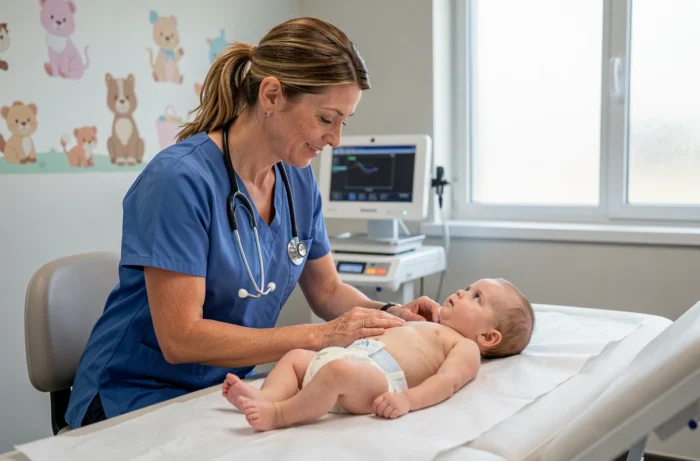
These reflexes are not mere curiosities. They allow the pediatrician to assess the neurological maturity of the infant during the first examinations. Their gradual disappearance between two and four months indicates that the brain is taking over from the birth automatism.
Have you noticed that your baby turns its head when you stroke its cheek? This is the rooting reflex, which helps it find the breast or bottle. Each reflex has a concrete function related to survival or feeding.
To track these developments over the weeks, you can explore the site carnetdebebe.fr and note the observations you make daily.

Infant Sleep: Safety Rules to Know
Sleep occupies most of a newborn’s time. The cycles are short, often fragmented, which confuses many young parents. Before trying to extend these rest periods, the priority is the safety of the sleep environment.
The recommendations from the Ministry of Health are clear: the baby sleeps on its back, flat, in its own crib, with a firm mattress. No bumper pads, pillows, duvets, baby wedges, or stuffed animals that could cover its face.
Before six months, the baby’s crib can be placed in the parents’ bedroom. Co-sleeping in the same bed, however, is not recommended, even for naps. Sleeping with the baby in your arms on a couch poses a high risk, even if it seems reassuring at the moment.
Key Points About Bedding
- One mattress per bed: never add a second mattress in a travel crib, as the space created between the two surfaces can trap the infant’s face.
- No blankets or oversized sleeping bags: opt for a sleeping bag suitable for the baby’s size and the room temperature.
- A separate bed in the parents’ room until six months: this proximity facilitates nighttime breastfeeding while maintaining safety.
Baby’s Sensory Development in the First Months
The newborn perceives the world long before it can explore it with its hands. Its vision is blurry beyond about twenty centimeters, which corresponds to the distance between the parent’s face and the baby’s during feeding. This is not a coincidence.
Hearing, on the other hand, is functional from birth. Your baby recognizes your voice because it heard it during pregnancy, filtered by amniotic fluid. Low sounds and slow melodies capture its attention better than high-pitched or abrupt noises.
Touch plays a major role in the infant’s emotional regulation. Skin-to-skin contact after birth helps stabilize its body temperature and heart rate. This is not just a moment of tenderness; it is a measurable physiological act.
Stimulate Without Overstimulating
Offering visual contrasts (black and white images, objects with simple shapes) helps the baby focus its gaze. Speaking to it with varied intonations nourishes the neural connections related to language. However, multiplying simultaneous stimuli tires the infant more than anything else.
A baby that looks away or starts to cry after a moment of play signals that it has reached its limit. Respecting this signal is already supporting its development.
Screens and Infants: A Clear Boundary to Set
International recommendations published between 2024 and 2026 are unequivocal: no screens before two years, including in the background. It is no longer just about limiting exposure time but aiming for an almost complete absence of screens during the first two years.
Why such a firm stance? The infant’s brain develops primarily through direct human interactions: gaze, voice, touch, responses to its babbling. A screen, even if turned on in the room without the baby looking directly at it, reduces the quantity and quality of verbal exchanges between the parent and child.
In practical terms, this also means that a phone placed on the table during meals or the television playing in the background counts as indirect exposure. Replacing the screen with moments of conversation and free play remains the most effective lever to support the baby’s cognitive and language development.
Feeding and Growth: Breast Milk or Formula, the Guidelines
During the first months, milk (breast or formula) is the sole source of nutrition. Solid food introduction does not begin until four to six months of age, according to current pediatric recommendations.
The rhythm of feedings or bottles varies from baby to baby. Some infants demand to be fed every two hours, while others space it out more. Regular weight gain remains the best indicator of appropriate feeding, much more reliable than a strict timing of meals.
A detail often overlooked: frequent regurgitations in infants are, in the vast majority of cases, physiological. The sphincter between the esophagus and stomach is not yet mature. As long as the baby is gaining weight and shows no signs of pain, these refluxes generally do not require treatment.
The early stages of a baby’s life unfold quickly, and each child follows its own timeline. The reflex that disappears, the first social smile, the head that can be held up for a few more seconds each day: these small daily victories deserve to be observed closely rather than compared to a rigid norm.