
Your car breaks down on the side of a departmental road on a Sunday evening. The tow truck takes the vehicle, but you are left stranded there with your passengers. A taxi is necessary to get home. The question of payment arises immediately, and the answer depends less on the goodwill of the driver than on what is stated in your car insurance contract.
Car Assistance Coverage: The Mechanism That Decides Who Pays for the Taxi
It is often thought that the taxi after a breakdown is at our expense. In most cases, it is the insurer who covers this alternative transportation, provided that the car insurance includes an assistance guarantee.
This guarantee, present in comprehensive coverage plans and often offered as an option in intermediate plans, covers roadside assistance and towing, as well as alternative transportation methods: taxi, train, and sometimes even plane for long distances. When the car is immobilized due to a breakdown or accident, the insurer organizes and finances the return trip or continuation of the journey.
The reflex to have: call the taxi assistance number in case of breakdown listed on your green card or in your client area, before booking anything yourself. If you take a taxi without going through the assistance platform, reimbursement is not guaranteed.
Each contract sets a coverage limit. Beyond that, the rest is your responsibility. Returns on this point vary according to insurers, hence the usefulness of reviewing the specific conditions before being stuck on a highway rest area.
0 km Assistance: The Clause That Changes Everything for a Home Breakdown
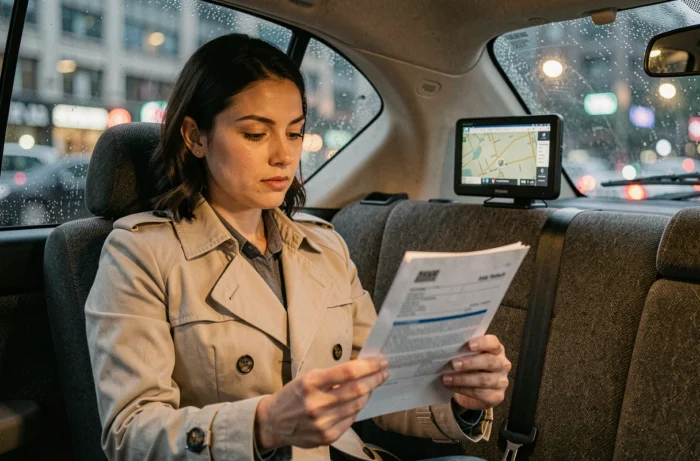
Breakdowns do not always occur in the middle of nowhere. A dead battery in front of your house on a frosty morning, a starter failing in the parking lot of your residence: these situations are common. Without the right option, there is no coverage.
The 0 km assistance clause removes the classic mileage deductible. Normally, many contracts only intervene beyond a certain perimeter around the home. With the 0 km option, a breakdown in front of your door triggers the same services as a breakdown several hundred kilometers away: roadside assistance, towing, and taxi or replacement vehicle.
This option is widely offered in comprehensive coverage plans. In intermediate plans, it can be subscribed as an add-on for a often modest additional cost. For daily commuting, it is a safety net that prevents you from having to pay for a taxi at the last minute on a day when the bus doesn’t run.
Taxi or VTC Breakdown During a Ride: Responsibility of the Transporter
The reverse scenario also exists. You are a passenger in a taxi or VTC, and it is this vehicle that breaks down mid-ride. The rules change completely.
The driver is required to ensure the service until the destination. Their contractual obligation to transport does not cease because their engine stalls. In practice, they must arrange for a replacement vehicle or a second taxi to complete the ride, at no extra cost to the passenger.
Taxi and VTC drivers take out professional liability insurance that covers this type of incident. For VTCs, professional liability is mandatory and generally includes coverage for the consequences of a vehicle breakdown during a ride. On the taxi side, professional insurance includes similar guarantees.
- You should not pay for a second ride if the taxi breaks down before reaching the destination.
- The driver contacts their dispatch or insurer to arrange for a replacement.
- If the driver asks you to pay a supplement, you have the right to refuse and report the situation to the prefecture or the DGCCRF.
Replacement Vehicle and Other Alternatives Covered by Insurance
The taxi is not the only solution offered by insurers after a breakdown. Depending on the contract, the assistance guarantee may also include a replacement vehicle, provided for the duration of the repair.

The duration of the loan varies from one contract to another, ranging from a few days to more than a week for the most comprehensive plans. The replacement vehicle is particularly useful when the breakdown occurs far from home, for example on vacation, and the repair takes time.
Some plans also offer reimbursement for hotel nights if the vehicle is immobilized while traveling. These guarantees are typically found in contracts targeting high-mileage drivers or families.
- Replacement vehicle loaned directly by the insurer or a rental partner.
- Coverage for taxi or train for the return home if the repair exceeds a certain timeframe.
- Emergency accommodation reimbursed within the limit of the contractual ceiling.
Concrete Steps to Obtain Reimbursement for a Taxi After a Breakdown
The reimbursement procedure depends on when you contact your insurer. Calling assistance before taking the taxi simplifies everything: the insurer sends a contracted vehicle directly and pays the bill.
If you had to take a taxi urgently without going through assistance (breakdown in a white zone, at night, sick child in the car), keep the receipt and proof of breakdown (service receipt, mechanic’s report). Send these documents to your insurer within the deadlines specified in the contract, usually a few business days.
Reimbursement is based on actual expenses, within the limit of the specified ceiling. If the taxi bill exceeds this ceiling, the difference remains your responsibility. Also check that the chosen taxi meets the insurer’s criteria: some contracts exclude VTCs or require a partner provider.
A often overlooked point: the medical transport prescription has nothing to do with this situation. It only concerns trips to care reimbursed by Health Insurance via a contracted CPAM taxi. Confusing the two processes delays reimbursement and generates file refusals.
Keep your green card accessible, know your insurer’s assistance number, and review your contract limits once a year: three simple actions that prevent you from having to pull out your credit card at the wrong time.