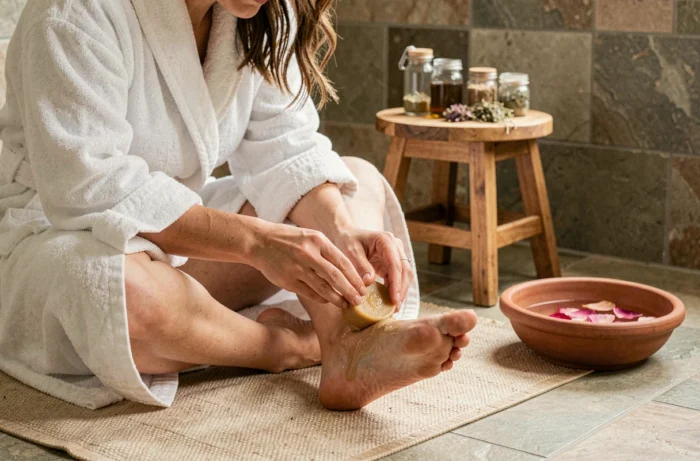
When you spend the day standing, stuck in closed shoes, your feet endure without saying a word. Calluses thicken, skin tightens, nails weaken: the signals often come late. Natural foot care allows you to act before discomfort sets in, with simple ingredients whose composition you control.
Limitations of natural remedies for feet: what research really shows
It is said everywhere that vinegar, baking soda, or Epsom salt solve sweating and odors. The reality is more nuanced. Most of these remedies are based on plausible mechanisms or a tradition of use, but no solid clinical trial measures their effectiveness on sweating or foot odor.
Vinegar, for example, can irritate and crack the skin, especially in diabetic individuals. Baking soda and salt also lack clinical evidence regarding sweat regulation. Presenting them as guaranteed solutions skips a step.
On the side of essential oils (tea tree, sage, palmarosa), antibacterial activity is observed in the lab. But in vitro effectiveness does not mean results on the skin under real conditions. When choosing products formulated by specialists like Calcea, you benefit from compositions designed for daily use, with dosages suitable for foot skin.
Maintaining a clear view of the limitations does not disqualify natural care. It simply avoids confusing tradition of use with proof of effectiveness.

Tea tree essential oil and nail fungus: real activity, uncertain healing
Tea tree is probably the most cited essential oil for foot problems. Its antifungal activity is documented in the lab, and that’s a fact. In vitro studies confirm that it acts against several strains of fungi responsible for nail fungus.
The problem lies in the next step. Complete healing of a nail fungus with tea tree alone remains uncertain under real conditions. The nail is a thick barrier, and the penetration of an essential oil applied on the surface is not always sufficient to reach the fungus lodged under the keratin.
You can use tea tree as a complement, diluted in a vegetable oil, to limit surface proliferation. But expecting total disappearance of the fungus without medical advice risks allowing the infection to progress for months.
Practical application on an affected nail
A few drops of tea tree diluted in black seed oil (which has also been studied for its antifungal properties), applied to the nail morning and evening. Feedback varies on this point: some people notice a visual improvement, others do not. If the nail continues to thicken or change color after several weeks, an antifungal prescribed by a healthcare professional remains the most reliable path.
Foot soak with salt: muscle relaxation and care for dry skin
A foot soak remains the most accessible natural gesture. No special equipment is needed: a basin, warm water, coarse salt or Epsom salt. The goal is not to cure anything, but to soften calluses and release muscle tension after a day of standing.
Warm water dilates blood vessels and promotes local circulation. The salt helps gently exfoliate dead skin. A few drops of lavender essential oil add a relaxing effect, without therapeutic claims.
Frequency and precautions for an effective foot soak
You do not soak your feet every day. One to two soaks per week are enough to maintain skin flexibility without weakening it. Here are the points to respect:
- The water temperature should remain comfortable, never scalding, to avoid aggravating already dry or reactive skin
- The duration does not exceed about twenty minutes; beyond that, the skin becomes macerated and loses its barrier function
- After the soak, dry thoroughly between the toes to prevent fungal proliferation in damp areas
- Diabetic individuals or those with circulatory disorders should consult their doctor before starting, as vinegar and very hot water are contraindicated in these cases
Natural foot hydration: vegetable oils and butters versus conventional creams
The skin on the feet is thicker than that on the rest of the body, but it lacks sebaceous glands on the sole. Without external fat supply, it dries out and cracks. This is where natural fats become essential.
Shea butter penetrates the thick stratum corneum better than many water-based creams. Applied in the evening under cotton socks, it works all night. Coconut oil, often mentioned, is also suitable but remains more superficial on very callused skin.
The advantage of these fats over conventional creams is the ingredient list. Raw shea butter contains only shea butter. No synthetic preservatives, no potentially irritating fragrances. You know what you are applying.
Homemade scrub before hydration
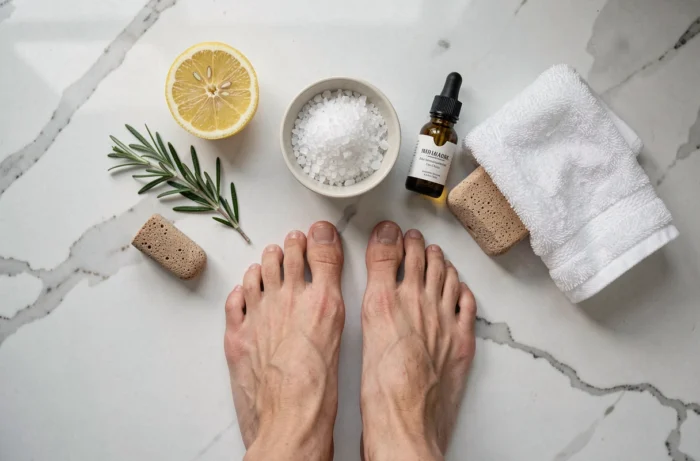
To allow the fat to penetrate, you first need to remove dead skin. A mixture of coarse salt and olive oil, massaged in circular motions on the sole and heels, makes an effective scrub. Focus on friction areas without forcing on cracks, risking worsening the fissures.
- Fine salt for sensitive skin, coarse salt for thick calluses
- Olive, sweet almond, or jojoba oil as the fatty base of the scrub
- Frequency of once a week to avoid excessively thinning the skin’s protective layer
Natural foot care works best when used regularly and discerningly. No natural ingredient replaces a medical diagnosis in the face of persistent fungus, chronic pain, or a wound that does not heal. But for daily maintenance, callus prevention, and general comfort, simple gestures with raw ingredients are more than enough to keep feet supple and healthy.